


How Camphor Is Made in Our Gorakhpur Workshop: From Raw Crystal to Sealed Pouch
A step-by-step walk through the Shiv Shakti workshop — sorting, conditioning, pressing, curing, burn testing and moisture-proof…
Sitaram Jaiswal 7 min
That black ring on your thali is not smoke from the flame. It is unburnt fuel, and it tells you exactly what was in the tablet.
Every few weeks somebody brings a blackened aarti lamp to our counter and asks whether the camphor was bad. The lamp answers the question by itself. A clean burn and a sooty burn are two different chemical events, and once you know what is happening it becomes very hard to be sold a bad tablet again.
Most solids melt into a liquid before they burn. Camphor skips that step. At ordinary room temperature it is already turning slowly from solid straight into vapour, which is why an open pouch loses weight on the shelf, and why the whole cupboard smells of it within a day.
When you touch a flame to a tablet, you are not really lighting the solid. You are lighting the vapour above it. That vapour burns in air with plenty of oxygen around it, which is what gives camphor its tall, clean, almost transparent flame — and it is why nothing is left on the plate. The solid has gone into the air, completely.
Soot is unburnt carbon. It appears when a fuel is burning without enough oxygen reaching the flame — a condition called incomplete combustion. Long-chain fuels like paraffin wax are especially prone to it, which is why a candle with a bad wick smokes and a candle with a good one does not.
Put paraffin on an open plate with no wick at all and you get the worst version of this. The wax melts, forms a pool, and the pool feeds a low, oxygen-starved flame that throws carbon upward. That carbon lands on the nearest cool surface — your idol, the wall behind the shelf, the underside of the lamp.
A quick way to see it. Hold a cold steel spoon a few centimetres above the flame for two seconds. Over pure camphor the spoon stays clean. Over a waxed tablet it comes away grey. This is test two from our six purity tests, in its fastest form.
The second giveaway is what stays behind. Pure camphor leaves nothing — at most a faint white bloom of re-condensed vapour that wipes off with a dry cloth. A wax-cut tablet leaves a hard grey or brown deposit, because the wax that did not burn simply cooled back into a solid.
Once that deposit is on brass it bonds with the heat and needs scouring. Families who complain that their thali needs polishing every week are usually describing a camphor problem, not a cleaning problem.
Three things decide whether a tablet burns cleanly, and all three happen before it reaches the pouch.
One tablet from each batch is burnt on a white ceramic tile in still air. We record three things: the time to ignition, whether the flame stays up without help, and the state of the tile once it has cooled. A batch passes only if the tile is clean.
It is a deliberately simple test, because it is the same test a customer can run at home. Nothing we claim on the quality page needs a laboratory to verify.
Price per gram is a poor guide, because a waxed tablet weighs more for the same money. Judge by the plate instead. If a pack leaves your thali clean, it is doing its job; if it does not, no price makes it worth it — least of all in a room where a family sits and breathes every evening.
Clean plate, every time. Our tablets, slabs and pouches are pressed from 100% camphor with no wax and no filler.
Shop camphor that burns cleanThe purity bench at our Gorakhpur workshop — the people who run the burn, residue and fragrance checks on every batch before it is sealed and boxed.
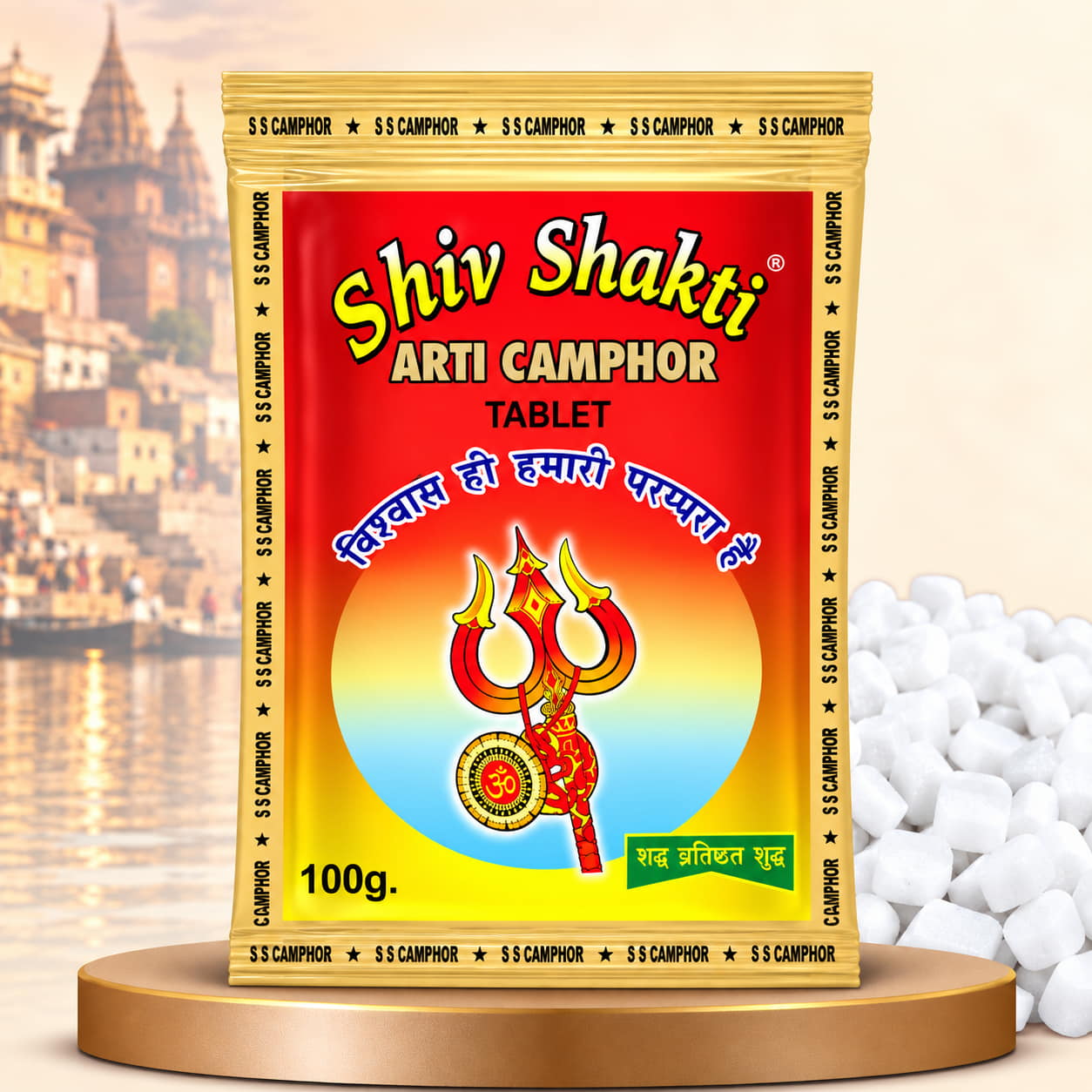
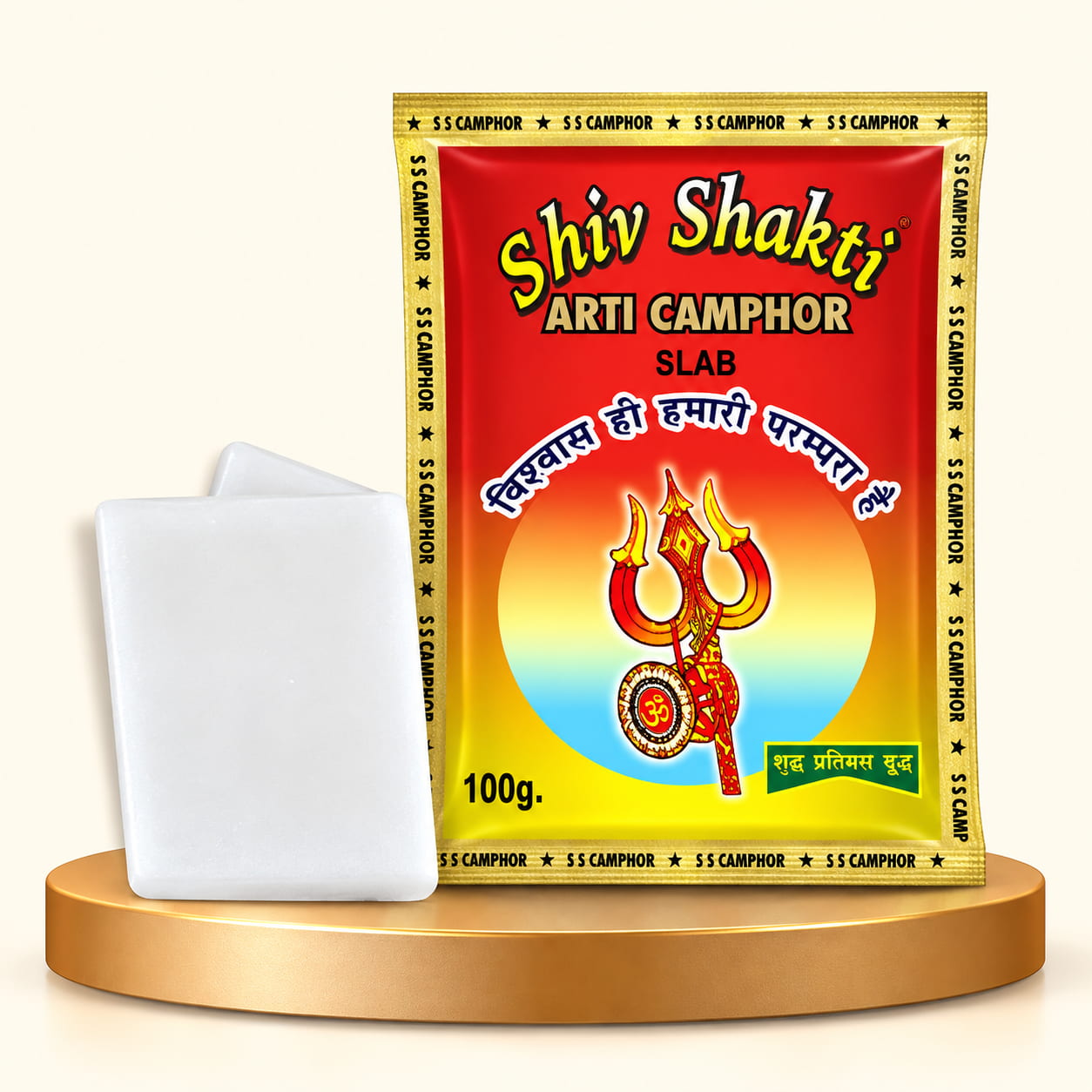
Pressed, cut and packed in our own Gorakhpur workshop — the exact packs mentioned above.
Still wondering
Black marks are soot — unburnt carbon from a fuel that is not getting enough oxygen. Camphor itself does not do this; paraffin wax on an open plate does, because it melts into a pool and smoulders instead of burning cleanly. A blackened thali almost always means a cut tablet.
No. Camphor sublimates, which means it passes straight from solid to vapour without a liquid stage. That is why it leaves nothing behind and why an open pouch loses weight on the shelf.
Hold a cold steel spoon a few centimetres above the flame for two seconds. Over pure camphor the spoon stays clean; over a wax-cut tablet it comes away grey.
More answers on our help centre.
More from Quality & Craft and the rest of the journal.
A step-by-step walk through the Shiv Shakti workshop — sorting, conditioning, pressing, curing, burn testing and moisture-proof…
Six quick tests — flame, residue, water, smell, touch and label — that separate 100% pure camphor from a wax-cut tablet, using…
The right way to light camphor for a daily aarti — how much to use, where to place the lamp, which way to rotate it, and the five…